MERLIN Support Office
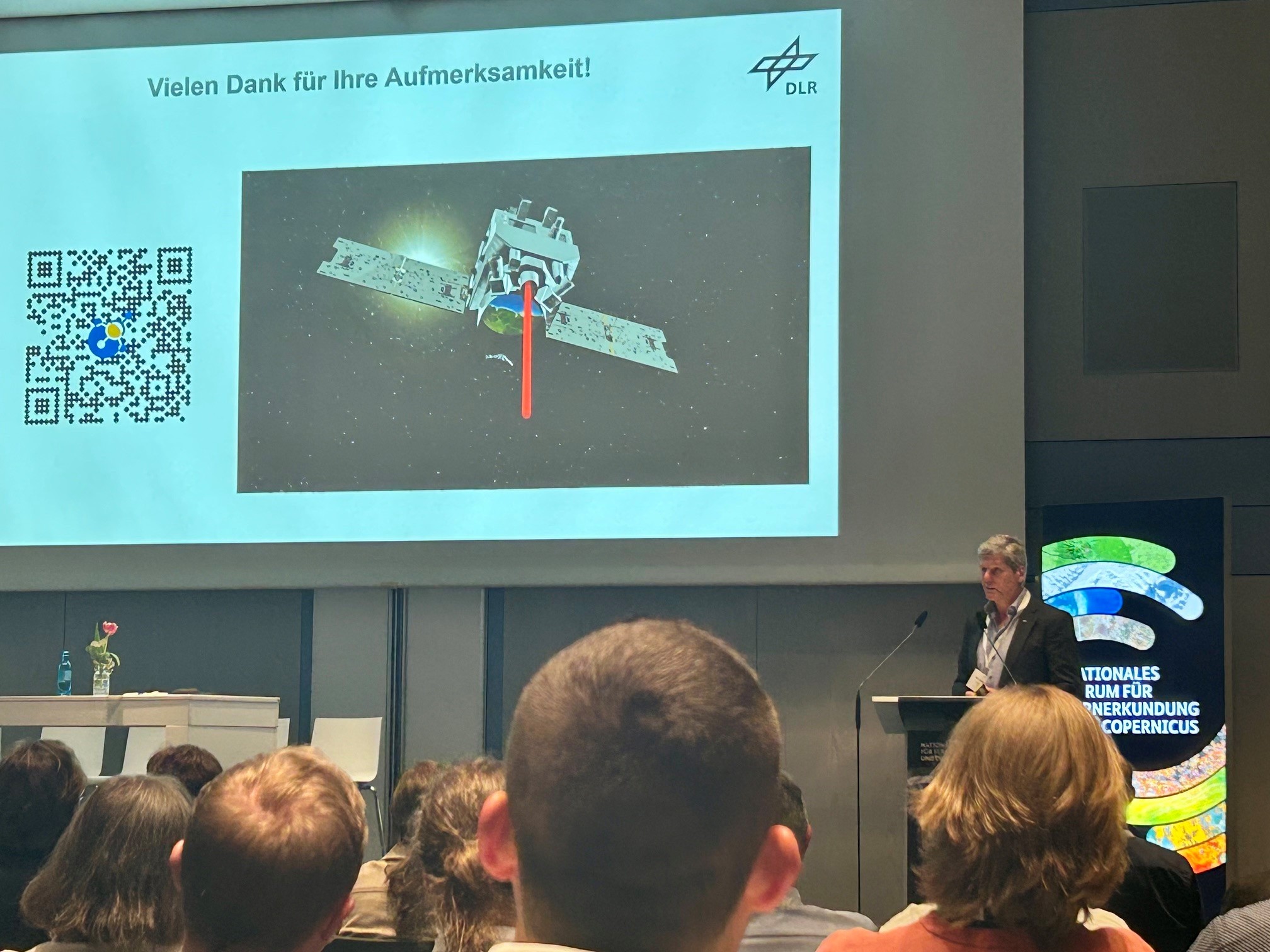
The National Forum for Remote Sensing and Copernicus 2026, held at the European Space Operations Centre (ESOC) in Darmstadt, brought together representatives from government, research institutions, industry and the European Earth observation community to discuss the future of satellite-based environmental monitoring and the evolution of the Copernicus programme. The event serves as Germany’s leading platform for knowledge exchange on Earth observation technologies, applications and policy development.
A particular highlight for the atmospheric monitoring community was the session on national Earth observation missions, where the Franco-German MERLIN (Methane Remote Sensing Lidar Mission) satellite was presented. MERLIN is the world’s first spaceborne lidar mission specifically designed to measure atmospheric methane concentrations on a global scale with unprecedented accuracy. By providing highly precise observations of methane sources and sinks, the mission will contribute to a better understanding of greenhouse gas emissions and support international climate action.
The presentation demonstrated how MERLIN complements the European Copernicus programme by delivering unique methane measurements that enhance existing Earth observation capabilities. The mission represents a significant contribution to Europe’s environmental monitoring infrastructure and highlights the importance of international cooperation between Germany and France in advancing climate science.
As Europe continues to strengthen its Earth observation ecosystem, MERLIN will play a key role in supporting climate research, emissions monitoring and evidence-based environmental policy. The mission exemplifies how innovative satellite technologies can provide actionable data for addressing global climate challenges while reinforcing Europe’s leadership in space-based environmental intelligence.
For more information about the mission, visit MERLIN Mission. Further details on the National Forum for Remote Sensing and Copernicus 2026 are available via Copernicus in Germany – National Forum 2026.