MERLIN Support Office
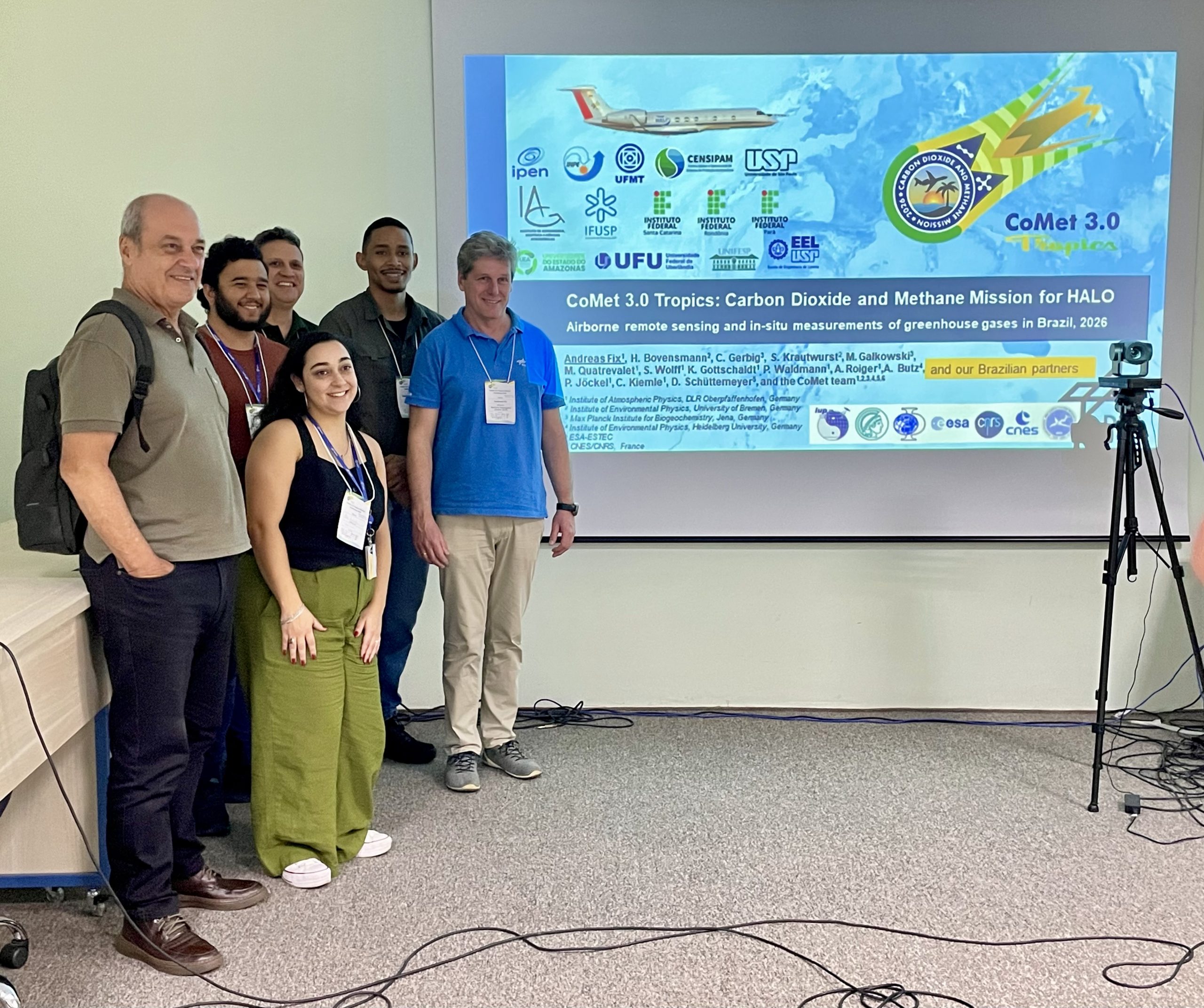
The CoMet 3.0 Workshop at the University of São Paulo (USP) brought together a distinguished group of scientists from Europe and Brazil to advance joint research on greenhouse gas (GHG) emissions and atmospheric monitoring. The event delivered fresh insights, stimulated open scientific exchange, and laid concrete groundwork for a sustainable, long-term partnership between partner institutions across two continents.
Over the course of two intensive days, participants explored the full scientific and logistical scope of the upcoming CoMet 3.0 airborne campaign. The agenda spanned cutting-edge topics including the latest research on Brazilian GHG emissions and observations, an in-depth overview of the CoMet mission concept, and technical deep-dives into the instrumentation aboard the HALO research aircraft. Key systems presented included CHARM-F (a CH₄ and CO₂ lidar), the MAMAP2D SWIR imaging spectrometer, mini-DOAS, and the Jena Air Sampler. These are tools that will be central to measuring carbon fluxes across the Amazon region.
Institutional breadth was a defining feature of the workshop. Representatives from DLR, ESA, University of Bremen, MPI-BGC, CNES and the German Embassy joined researchers from ATTO, CENSIPAM, and São Paulo’s own LEAL lidar group and many more. Discussions ranged from atmospheric transport modelling and weather forecasting to outreach strategies and joint data analysis frameworks. All this will underscoring the genuinely interdisciplinary character of the CoMet 3.0 effort.
The workshop concluded with a clear set of action items and a shared commitment to collaborative fieldwork. By strengthening the ties between European instrumentation expertise and Brazilian environmental knowledge, the CoMet 3.0 initiative is uniquely positioned to produce scientific results of global significance — contributing directly to our understanding of the Tropical carbon budget, supporting current and future GHG satellite missions and informing international climate policy.